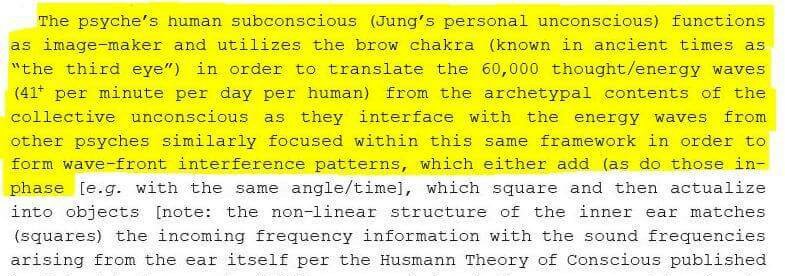
The holographic model suggests that the universe, at its most fundamental level, operates not as a collection of discrete, independent objects but as a vast interconnected network of relationships and patterns. This framework allows for an understanding of the immense capacity of both the brain and the universe to store and organize information. The example of holography demonstrates how vast quantities of information can be encoded within a small, seemingly finite space. Similarly, human memory and consciousness appear to operate by encoding and retrieving information in a manner that reflects this holographic principle, seamlessly integrating and reinterpreting fragments into coherent wholes.
This model is rooted in the work of David Bohm and Karl Pribram, who independently observed that the universe and brain, respectively, exhibit properties similar to holography. Bohm's insights from quantum physics revealed a reality composed of interdependent waveforms, implying that our perception of separateness is an illusion. Pribram's research in neurophysiology demonstrated that the brain processes information in a distributed, wave-like manner, suggesting memories and perceptions are not localized but are encoded holistically, as in a holographic plate.

Bohm's notion of the "holomovement" further extends this idea by framing the universe as a dynamic and indivisible process. Unlike traditional deterministic systems that follow predictable trajectories, the holomovement represents an unending flux of interconnected patterns and processes. This dynamic quality means that even seemingly isolated phenomena are part of a larger, flowing reality. This perspective challenges traditional scientific notions of cause and effect, which often assume linear relationships between events. Instead, Bohm argues for an understanding of causality that embraces the infinite interconnectedness of all phenomena, where each event is both a cause and an effect within an ever-changing system.
The discussion (still referring to the concepts brought forth in pages 156-161 by Manya J. Long's Psyche as Interaction) then turns to how perception operates within this dynamic framework. The human visual system, for example, is not merely a passive receiver of external stimuli but an active participant in constructing the reality we experience. The process by which images are formed on the retina and subsequently interpreted by the brain is a complex interplay of discrete, quantized events. Light waves striking the retina are translated into neural signals, which are then processed by the brain into coherent visual experiences. However, this process involves a series of unconscious intervals where the brain essentially "fills in the gaps" to create a continuous sense of reality. These intervals are so brief—fractions of a second—that we are typically unaware of them. Yet they are essential for constructing the seamless, dynamic flow of our conscious perception.
An intriguing aspect of this process is the role of periodicity and oscillation in perception. The texts describe how the human brain operates within specific frequency ranges, bridging moments of consciousness and unconsciousness to maintain a stable experience of reality. This rhythm underpins not only perception but also fundamental structures such as DNA, music, and language. The periodic nature of these processes ensures continuity and stability, enabling the brain to build up and sustain coherent images and thoughts from fleeting sensory inputs.
The author's anecdote provides a vivid example of what happens when this process is disrupted—reminding me of an experience I had on October 31st, 2016, which I will describe a little later on. She recounts walking along an outdoor breezeway when, for a brief moment, her familiar surroundings—brick walls and a concrete sidewalk—seemed to vanish. In their place, she perceived an indistinct, geometrical void. This unsettling experience, though brief, revealed the underlying mechanics of her perception. During the interval of 0.8 to 1.2 seconds when her brain was constructing an image of her surroundings, she momentarily became aware of the process itself. Instead of experiencing the final, polished "movie" of reality her brain typically presents, she glimpsed the raw, unformed data being assembled. This realization showcases how perception is not an automatic or passive phenomenon but a dynamic construction requiring precise timing and synchronization.
Bohm's ideas on the implicate and explicate orders also come into play here. The implicate order refers to the deeper, unobservable patterns that underlie reality, while the explicate order represents the tangible, structured reality we experience. The author's experience with the sidewalk can be seen as a momentary lapse where her brain's usual process of unfolding the implicate order into the explicate broke down. For a brief moment, she was exposed to the formless potentiality from which her conscious perception typically emerges. This aligns with Bohm's view that reality is not a fixed, static entity but a continuous interplay of unfolding and enfolding patterns.
The brain acts as both a receiver and interpreter of the dynamic patterns that constitute reality, constantly constructing and reconstructing the world we experience. This process, though largely unconscious, occasionally reveals itself in moments of disruption, offering glimpses into the intricate mechanics of our perception and its relationship to the larger cosmos.
"You have heard the expression before, I am sure, that the environment expresses a particular individual's personality. I am telling you that this is a literal and not symbolic truth. The letters upon the page have the reality only of ink and paper. The information they convey is invisible. As an object, this book itself is only paper and ink. It is a carrier of information.
You may perhaps argue that the book was manufactured physically, and did not suddenly erupt through Ruburt's skull, already printed and bound. You in turn had to borrow or purchase the book, so you may think, 'Surely, I did not create the book, as I created my words.' But before we are finished, we will see that basically speaking, each of you create the book you hold in your hands, and that your entire physical environment comes as naturally out of your inner mind as words come out of your mouths, and that man forms physical objects as unselfconsciously and as automatically as he forms his own breath." - Seth via Jane Roberts
On October 31st, 2016, I was reading New Dimensions for the Cube of Space: The Path of Initiation Revealed by the Tarot upon the Qabalistic Cube by David Allen Hulse. I had already read the chapter and was going back over a specific page to reference something. As I revisited that part, I watched the book page rearrange itself right before my eyes, with entirely new sections and words appearing that hadn’t been there before.
In Qabalistic teachings, each Hebrew letter corresponds to an element, planet, or sign. The letter Mem (מ) is associated with water, symbolizing the flow of consciousness and the depths of the subconscious mind. The Hanged Man, associated with the letter Mem, is often depicted suspended upside down, with his head either near or submerged in water (or, similarly, the roots), indicating immersion into deeper states of awareness and the subconscious. This imagery suggests a surrender to the flow of inner consciousness.
The Hanged Man is typically shown hanging by one foot from gallows resembling the Hebrew Letter Tau (or Tav). The figure is often depicted with his leg forming a cross, also reminiscent of the Tau (ת) cross. The Tau cross represents completion. In some traditions, the figure is suspended by an ankh (ankh/ankle/angle)—a symbol of life and eternal existence—attached to his ankle.
Astrologically, the planet Saturn is associated with the concept of time, limitations, and structure. In the Qabalistic Tree of Life, Saturn corresponds to the sephirah Binah, representing understanding and the primordial 'Dark Sea'—a metaphor for the vast, unformed potential of the universe. The World card in tarot, numbered 21 (reflecting 12, The Hanged Man), is connected to Saturn and the Great Sea of Binah, and the ability to see/sea under the surface, to sea/see the interconnectedness of All That Is.
"The first truth that I must relate is that we are all surrounded by infinity. As you look around, you might think that you are a being that lives in a world surrounded by objects and that you are an object yourself, albeit a sentient one.
Alchemists, though, discovered a very long time ago that we are all lost in a perceptive illusion. This illusion hides the fact that there are no objects Out There; there is only energy. While some could argue that there are certain energetic conglomerations that might act upon humanity in a way that we have learned to describe as objects, the fundamental reality is that those objects (and the solidity that we ascribe to them) is an illusion—an imposed illusion!
Alchemists would say that we are, in fact, surrounded by infinity, which could more succinctly be described as an immeasurable Dark Sea." - John Kreiter

"You are alive now, a consciousness knowing itself, sparkling with cognition amid a debris of dead and dying cells; alive while the atoms and molecules of your body die and are reborn. You are alive, therefore, in the midst of small deaths; portions of your own image crumble away moment by moment and are replaced, and you scarcely give the matter a thought So, you are to some extent now alive in the midst of the death of yourself - alive despite, and yet because of, the multitudinous deaths and rebirths that occur within your body in physical terms.
If the cells did not die and were not replenished, the physical image would not continue to exist, so now in the present, as you know it, your consciousness flickers about your ever-changing corporeal image. In many ways you can compare your consciousness as you know it now to a firefly, for while it seems to you that your consciousness is continuous, this is not so. It also flickers off and on, though as we mentioned earlier, it is never completely extinguished" - Seth through Jane Roberts
"Other ancient civilizations also had similar concepts for the 'undifferentiated matrix of the unconscious, an existence bathed in the pre-egoid memories of the watery abyss of our life within the womb,' describes Jill Purce in The Mystic Spiral. 'In ancient Egypt the primordial vibrational field (called nada in India) is called Nun, the primal ocean. It is the One imaged as undifferentiated cosmic substance,' explains Robert Lawlor in Sacred Geometry.
Modern physicists, such as David Bohm refer to a 'sea of electrons', or to an 'energy sea', as Heinz Pagels does in The Cosmic Code, or a 'simultaneous everywhere present matrix' per Ken Wilber in The Holographic Paradigm; These physicists sense of the wholeness of reality can be echoed in the concept used to describe awareized thought/energy fields of the collective unconscious as framework 1 (i.e. the unconscious interval of .8s-1.25s) from where the individual conscious minds form the objects and events in framework 2 (i.e. the conscious interval of .95s-1s). In order to describe the awareized thought/energy fields of the collective unconscious as Framework 2 from where the individual conscious minds form objects and events.
Seth refers to these 'blueprints' or models of objects as 'patterns-out-of-focus' in The Seth Material and, echoing this concept in The Dancing Wu Li Masters, Gary Zukav refers to '"matter" as actually a series of patterns out of focus.' In order to explain that, he says, 'According to particle physics, the world is fundamentally dancing energy; energy that is everywhere and incessant assuming first this form and then that.'" - Manya J. Long
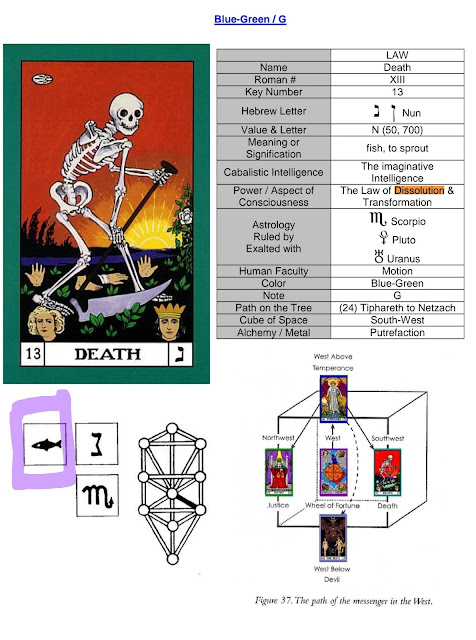
From the Book of Tokens by Paul Foster Case
The phrase "The Fish (Nun) and the Sea (Mem) are One" draws on the relationship between Nun, representing the fish, and Mem, symbolizing the sea. This concept emphasizes unity and interconnectedness, illustrating how the fish, a living entity, cannot exist independently of the sea, which represents the medium of existence itself.
The sea (Mem) is a metaphor for the infinite and boundless potential of creation, equivalent to the primordial waters or the Dark Sea of Binah. Meanwhile, the fish/seed (Nun - or Motion/"M"(Mem)Ocean) signifies the individual spark of life, the dynamic force navigating within this vast expanse. The fish, though distinct, is inseparably tied to the sea—it is nourished by, sustained by, and moves within the sea.
This unity encapsulates a fundamental mystical teaching: that all apparent separateness is an illusion. The fish does not exist apart from the sea, and the sea is enriched by the life and movement of the fish within it.

"All forms must change and what changes them is imagination. The universal imagination performs the greater transformation♏, but the imagination of man is no different ... Its essential nature is shown by the root-meaning of the verb NUN—to sprout, to PROPAGATE BY SPROUTING." - Paul Foster Case
"Chokmah [Wisdom] is held to be the seat of the life-force in man, while Tiphareth, or Beauty [the Son/Sun], is regarded as the seat of imagination♀️. Thus the word ABN intimates that the First Matter is identical with the life-force, and that it is also the power which expresses itself in our lives as the active principle in the production of mental imagery." - Paul Foster Case





.gif)